Getting paid every two weeks sounds simple, but it creates a problem most monthly budgets ignore: your bills run on a monthly clock while your income runs on a two-week one. Rent is due on the 1st, but your paycheck might land on the 3rd. Groceries need buying every week, but your money arrives in two big chunks. If you have ever felt rich the day after payday and broke the week before the next one, this mismatch is why.
Learning how to budget biweekly paycheck income fixes the timing problem at its root. Instead of stretching one monthly plan across two paydays, you build your budget around the paychecks themselves. This guide shows you exactly how, with a worked example, a plan for three-paycheck months, and the mistakes to avoid.
What Is a Biweekly Budget?
A biweekly budget matches your spending plan to your two-week pay cycle. Instead of one monthly budget, you assign every bill to the paycheck that arrives before its due date and split bills like rent in half across both checks. This ends the “rich after payday, broke before payday” cycle.
A biweekly budget is not a different kind of budgeting. It is the same idea — giving every dollar a job — organized around paydays instead of calendar months. That one change solves the timing problem that makes monthly budgets fail for biweekly earners.
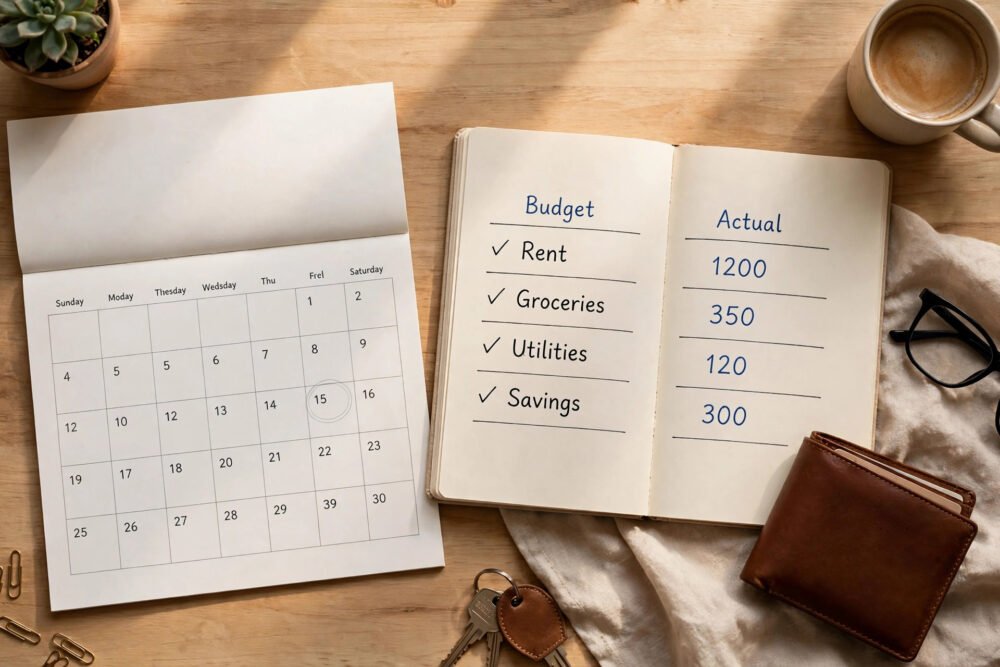
[IMAGE SUGGESTION: A clean desk with a paper calendar, a paycheck, and a notebook showing two columns labeled Paycheck 1 and Paycheck 2 — alt text: “biweekly budget plan with two paycheck columns on a calendar”]
Biweekly vs Semimonthly: Why the Difference Matters
Many people confuse biweekly pay with semimonthly pay, and the difference is worth real money.
Biweekly pay means a paycheck every 14 days, usually every other Friday. That adds up to 26 paychecks a year.
Semimonthly pay means two paychecks a month on fixed dates, like the 1st and 15th. That adds up to 24 paychecks a year.
The two extra checks are the whole point of this article. If your take-home pay is $2,000 per check:
| Pay schedule | Checks per year | Annual take-home |
|---|---|---|
| Biweekly | 26 | $52,000 |
| Semimonthly | 24 | $48,000 |
The difference is $4,000 a year — a full extra month of income that biweekly earners get and semimonthly earners do not. The catch: it arrives in two lump sums, twice a year, in months with three paydays. Budget as if you only get two checks a month, and those two extra checks become pure progress. Budget as if you get three, and you will run short the other ten months.
Step-by-Step: How to Budget Biweekly Paycheck
Step 1: Find Your Real Take-Home Pay Per Check
Use the number that actually lands in your bank account, not the gross salary on your pay stub. Taxes, retirement contributions, and insurance come out first. If your pay varies slightly, use your lowest recent check as your planning number. You can always do more with a bigger check; a smaller one should never break the plan.
Step 2: List Every Bill With Its Due Date
Write down every fixed bill: rent or mortgage, utilities, car payment, insurance, phone, internet, subscriptions, and minimum debt payments. Next to each one, write the amount and the day of the month it is due. Then add the spending that repeats every pay period but has no due date: groceries, gas, and household basics.
Step 3: Assign Each Bill to a Paycheck
The rule is simple: a bill belongs to the last paycheck that arrives before its due date, with a few days of margin. Rent due on the 1st comes out of the check from the last week of the previous month. A car payment due on the 15th comes out of the check that lands around the 9th.
If one paycheck ends up badly overloaded, you have two fixes. Many lenders and utilities will move your due date if you ask, and spreading due dates across the month is free. Or you can split a large bill in half, which is Step 4.
Step 4: Split Large Bills in Half
This is the move most biweekly guides mention but few explain properly. Take your biggest monthly bills — usually rent — and set aside half from each paycheck. If rent is $1,200, you move $600 from Paycheck 1 and $600 from Paycheck 2 into a bills account, and the full amount is waiting when the 1st arrives.
Splitting bills evens out both paychecks, so neither one feels impossibly tight. Within two or three pay cycles, you stop paying bills from money you are waiting for and start paying them from money you already have. That is the moment the broke-before-payday cycle ends.
Step 5: Give Each Paycheck Its Own Spending Money
After bills and savings, whatever is left is your spending money until the next payday. Divide it by two to get a weekly number, or by fourteen for a daily one. Groceries and gas get their own lines in each paycheck’s plan, not one big monthly guess. And give yourself a small fun-money line in every check. A budget with zero room for enjoyment is a budget you will abandon.
Step 6: Build a One-Week Buffer
Keep a cushion of about one week’s spending in your checking account. Paychecks sometimes arrive late, bills sometimes arrive early, and a $100 to $200 buffer means a small timing gap never becomes an overdraft fee. Build it once, then protect it: if you dip into it, refill it from the next check before anything else.
Step 7: Automate Within 24 Hours of Payday
Set up automatic transfers that move money to savings, debt payments, and your bills account within a day of each deposit. Automation removes willpower from the equation. The money is assigned before you have a chance to spend it, which is exactly the point of a biweekly budget: every dollar has a job before the paycheck even feels like spending money.
A Worked Example: $1,850 Per Paycheck
Here is what this looks like with real numbers. Take-home pay is $1,850 per check, rent is $1,100, and the goal is $250 of savings per check.
Paycheck 1 — $1,850
| Expense | Amount |
|---|---|
| Rent (half) | $550 |
| Electric bill | $130 |
| Car insurance | $150 |
| Groceries (weeks 1–2) | $280 |
| Gas | $140 |
| Savings | $250 |
| Fun money | $100 |
| Total | $1,600 |
Wait — that leaves $250 unassigned, and an unassigned dollar is a dollar that disappears. In this plan, the leftover goes to the bills account as a head start on next month’s rent. Every paycheck should zero out: income minus everything assigned equals zero.
Paycheck 2 — $1,850
| Expense | Amount |
|---|---|
| Rent (second half) | $550 |
| Car payment | $320 |
| Phone bill | $80 |
| Internet | $70 |
| Groceries (weeks 3–4) | $280 |
| Gas | $140 |
| Savings | $250 |
| Extra debt payment | $160 |
| Total | $1,850 |
Notice the balance. Rent is split, groceries and gas appear in both checks, and savings come out of both. Neither paycheck carries all the weight, and the second check still has room for an extra debt payment. That is a biweekly budget working the way it should.
How to Budget Biweekly Paycheck in Three-Paycheck Months
Twice a year, a month holds three paydays instead of two. Because your bills are sized for two checks, the third check arrives with no obligations attached. The only rule that matters: decide what it does before it arrives. A paycheck without a plan vanishes into everyday spending.
Here is the priority order most financial experts recommend:
| Priority | Use for the third check | Why |
|---|---|---|
| 1 | Emergency fund, if under 3 months of expenses | The foundation for everything else |
| 2 | Extra payment on your highest-interest debt | A guaranteed return equal to the interest rate |
| 3 | Sinking funds for irregular costs | Car repairs, holiday gifts, insurance renewals |
| 4 | Retirement (IRA or 401k) | Two extra checks can cover a large part of an annual IRA contribution |
| 5 | A planned goal or guilt-free spending | Only once the first four are handled |
If you are drowning in credit card debt, send 80% of the third check to debt and keep 20% for yourself so you do not burn out. If your emergency fund is at zero, send most of it there. The percentages are flexible; the advance decision is not.
One more detail: in rare years, depending on your payday weekday, you can get a 27th check. Treat it exactly the same way — a bonus with a job decided in advance.
How to Budget Biweekly Paycheck on Irregular Income
Hourly workers, tipped workers, and anyone with overtime that changes month to month need one adjustment. Base your regular budget on your lowest typical check, not your average. Cover bills, groceries, and minimum savings from that floor amount. When a bigger check arrives, the surplus goes straight to your buffer, your emergency fund, or debt — in that order.
If your income swings a lot, use percentages instead of fixed amounts: 50% of each check to needs, 30% to wants, 20% to savings and debt. The dollar amounts move with your pay, but the structure holds.
Biweekly Budget vs Monthly Budget
| Monthly budget | Biweekly budget | |
|---|---|---|
| Organized around | Calendar month | Paydays |
| Bills assigned | All at once | To the check before each due date |
| Three-paycheck months | Ignored or double-counted | Planned as bonus income |
| Risk | Running out mid-month | Low, if each check zeroes out |
| Best for | Salaried, monthly pay | Anyone paid every two weeks |
If you are paid biweekly, a monthly budget is not wrong — it is just the wrong shape. Reshaping it around paydays is usually the single change that makes budgeting finally stick.
5 Mistakes That Break a Biweekly Budget
1. Budgeting around your biggest month. Building your plan on three-check months guarantees a shortfall the other ten months. Always budget off two-check months.
2. Counting the third check before it arrives. It is not monthly income. Treat it as a bonus, and it becomes one.
3. Using gross pay instead of take-home pay. Taxes and deductions are not yours to spend. Plan from net pay only.
4. Skipping the buffer. Without a small cushion, one late deposit or early bill triggers overdraft fees that no spreadsheet can fix.
5. Putting all bills on one paycheck. If Paycheck 1 pays rent, insurance, and the car payment while Paycheck 2 pays almost nothing, the first half of every month will feel impossible. Split large bills and balance the load.
Quick-Start Checklist
- [ ] Write down your take-home pay per check
- [ ] List every bill with its amount and due date
- [ ] Assign each bill to the paycheck before its due date
- [ ] Split rent and other large bills in half across both checks
- [ ] Give each check its own grocery, gas, and fun-money lines
- [ ] Set up automatic transfers within 24 hours of payday
- [ ] Build a one-week buffer in checking
- [ ] Decide now what your next third paycheck will do
Frequently Asked Questions
Is biweekly pay the same as semimonthly pay?
No. Biweekly pay arrives every 14 days, giving 26 paychecks a year. Semimonthly pay arrives twice a month on fixed dates, giving 24 paychecks a year. Only biweekly pay creates three-paycheck months.
How many paychecks do you get in a year if paid biweekly?
Twenty-six, in most years. Twice a year a month will contain three paydays. In rare years, depending on your payday weekday, you may receive a 27th check.
What should I do with my third paycheck?
Decide before it arrives. The most effective order is: top up your emergency fund to 3–6 months of expenses, then pay extra on your highest-interest debt, then fund sinking funds for irregular costs like car repairs and holidays. Only spend it freely once those are handled.
How do I pay rent if it is due before my second paycheck?
Split it. Set aside half the rent from each paycheck into a bills account, so the full amount is ready on the due date. Within a few pay cycles you will be paying rent from money you already have.
Do I need a budgeting app to budget biweekly?
No. A spreadsheet or even paper works fine — the method matters more than the tool. What matters is assigning each bill to a specific paycheck and zeroing out every check. An app helps only if it makes that habit easier to keep.
Final Word
Budgeting a biweekly paycheck is not about discipline or deprivation. It is about timing. Match your bills to your paydays, split the big ones in half, give every check its own spending money, and decide what the third check does before it arrives. Do that, and the two-week cycle stops working against you — and starts working for you. Your next payday is the perfect time to start: list your bills tonight, assign them to checks tomorrow, and set up the first automatic transfer the moment the money lands.