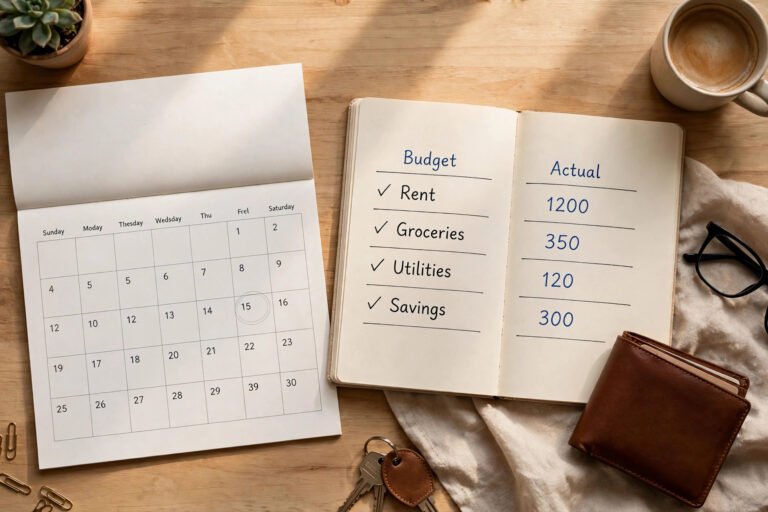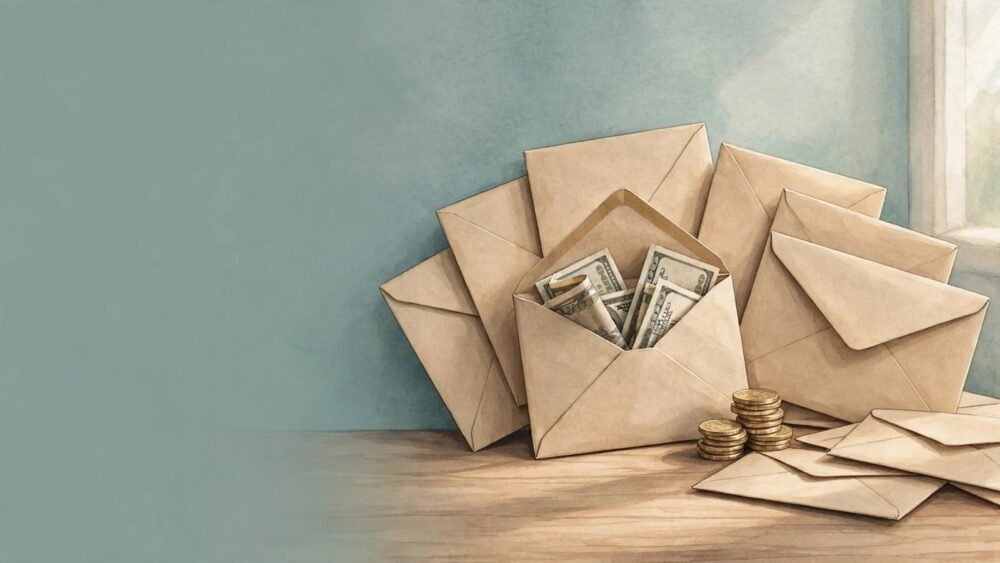
The cash envelope system for beginners is the oldest budgeting trick that still works, and it works for a reason most budgeting apps cannot copy: it makes spending hurt a little. You take the money for your flexible spending out of the bank as cash, split it into labeled envelopes — groceries, dining out, gas, fun money — and when an envelope is empty, spending in that category stops until the next payday. No tracking app, no spreadsheet, no willpower contest at the checkout. The limit is physical, and you can see it getting thinner.
If you have ever reached the end of the month wondering where the money went, this method answers that question before the month starts. It is especially powerful for the categories where you always overspend, because those are the categories where a card makes spending feel like nothing at all. This guide shows you exactly how to set the cash envelope system up in your first month, how much to put in each envelope, and what to do when one runs out early.
Cash Envelope System for Beginners: The Short Answer
The cash envelope system for beginners works like this: pick 4 to 6 flexible spending categories, assign each a monthly cash amount based on your last two months of real spending, withdraw that total on payday, and put the cash in labeled envelopes. Spend only from the matching envelope, and stop when it is empty. Anything left at month end goes to savings.
That is the whole system in one paragraph. The rest of this guide turns it into a plan you can start on your next payday, because the method only works when the amounts are real, the categories are few, and the rules are simple enough to survive a busy month.
What Is the Cash Envelope System?
The cash envelope system — also called envelope budgeting or cash stuffing — is a budgeting method where you divide your flexible spending money into physical envelopes, one per category. Each envelope holds the exact cash you budgeted for that category for the month or pay period. You pay for groceries from the groceries envelope, for fuel from the fuel envelope, and for a night out from the entertainment envelope. When an envelope is empty, that category is done until the next refill. There is nothing left to decide, and no overdraft to rescue you.
The method is a close cousin of zero-based budgeting, where every dollar gets a job before the month begins. The difference is the physical limit. A budget on a screen can be ignored with one tap. An empty envelope cannot be argued with, and that is the point.
Why does cash work when apps often do not? Researchers call it the pain of paying: handing over physical money registers as a real loss in a way that tapping a card does not. A widely cited Dun and Bradstreet study found that people spend 12 to 18 percent more on credit cards than on cash, and envelopes use that psychology on purpose — you watch the money leave your hand and the envelope get thin, so you make different choices before the money is gone, not three weeks later when the statement arrives.
The system is not about going cash-only for everything. Rent, utilities, insurance, loan payments and subscriptions stay on autopay from your bank account, exactly as they are now. Envelopes are only for the variable spending where your willpower is tested every week. That distinction is what keeps the system manageable, and it is the first thing most beginners get wrong.
How the Cash Envelope System for Beginners Works
Four rules run the whole method, and every successful envelope budgeter follows the same four.
Rule 1: Envelopes are for flexible spending only. Groceries, dining out, fuel, entertainment, personal spending and household supplies go in envelopes. Anything with a fixed amount and a due date stays on autopay. If you try to envelope rent and utilities too, you will be carrying a wallet full of cash for no reason, and you will quit in week two.
Rule 2: The amount in the envelope is the whole budget. There is no backup card for that category. If the dining-out envelope is empty on the 22nd, you cook at home until payday. The rule sounds harsh, and it is supposed to — the harshness is what makes the budget hold. The one exception is a genuine emergency, and an emergency is not a sale or a craving.
Rule 3: Refill on payday, not whenever you feel like it. Envelopes get filled when money arrives. If you are paid monthly, fill once a month. If you are paid biweekly, split each envelope in half and refill every payday. Smaller, more frequent fills are easier to carry and safer to lose.
Rule 4: Leftover cash is a win, not spare money. Whatever is left in an envelope at the end of the month goes to savings, debt, or next month’s envelopes — decided in advance, not spent on a reward. This is the part that quietly builds wealth: a system that turns unspent grocery money into savings every single month.
Which categories belong in envelopes and which stay digital? Here is the split that works for most households:
| Cash envelopes | Keep on autopay or card |
|---|---|
| Groceries | Rent or mortgage |
| Dining out and takeout | Utilities, phone, internet |
| Fuel and transport | Insurance premiums |
| Entertainment and hobbies | Loan and credit card payments |
| Personal spending and clothing | Subscriptions |
| Household supplies | Savings and retirement transfers |
| Gifts and kids’ activities | Online shopping |
| Each adult’s fun money | Irregular bills (pay from a sinking fund) |
Start with the two or three categories where you overspend most. Five to eight envelopes is enough for most households. Twenty envelopes is a filing system, not a budget, and you will abandon it.
Cash Envelope System for Beginners: Your First-Month Setup
Setting the system up takes one evening and one trip to the bank. Here is the whole setup, step by step.
Step 1: Find your take-home pay. Your budget number is what actually lands in your bank account after tax and deductions — not your salary, not your hourly rate times forty. If your hours vary, use your lowest month from the last three as the planning number. A budget built on a good month fails in a bad one.
Step 2: List your fixed costs first. Rent, utilities, phone, insurance, loan minimums, subscriptions. Add them up and subtract them from take-home pay. What remains is your flexible money, and your envelopes come out of that pot — never the other way around.
Step 3: Pick 4 to 6 categories. Choose the areas where you consistently overspend or lose track. For most beginners, that is groceries, dining out, fuel, personal spending, and entertainment. Do not envelope a category you rarely spend in. An envelope with $20 that sits untouched for three months is clutter, and clutter kills systems.
Step 4: Set the amounts from real data. Look at your last two months of bank or card statements and find your actual average spending per category. Then set each envelope 10 to 15 percent below that average. If you averaged $480 a month on groceries, the envelope gets $420. An envelope set at your old average changes nothing, and one cut in half guarantees failure — ten to fifteen percent is a stretch you can actually survive.
Step 5: Withdraw cash on payday and stuff the envelopes. Go to the bank on payday and pull out the total for all envelopes in cash. Ask for a mix of $20s, $10s, $5s and $1s — small bills make it easy to pay exact amounts and keep the change in the right envelope. Label each envelope with the category name and the dollar amount, and write the date and amount on the outside every time you take money out. That five-second habit shows you exactly where you stand mid-month, without opening an app.
Step 6: Spend only from the matching envelope. This is the rule that does the work. Groceries come from the groceries envelope, every time. Take the envelopes with you when you shop or go out — an envelope left at home is an excuse to use the card. When an envelope is empty, the category is closed until the next refill. In month one, do not borrow between envelopes. Later, once you know where the money actually goes, you can allow it — but first learn the truth about your spending.
A Worked Example: $3,000 a Month, 5 Envelopes
Abstract advice is easy to agree with and hard to follow, so here is a complete worked month. Take-home pay is $3,000 a month. Fixed costs — rent $1,100, utilities and phone $220, insurance $130, minimum debt payment $150, subscriptions $40 — total $1,640. That leaves $1,360 for flexible spending, savings and a buffer.
The envelope plan takes $900 of that, split across five categories, with the rest going to savings and a buffer for irregular costs:
| Envelope | Monthly amount | Per paycheck (biweekly) |
|---|---|---|
| Groceries | $400 | $200 |
| Dining out | $150 | $75 |
| Gas and transport | $120 | $60 |
| Personal spending | $150 | $75 |
| Entertainment | $80 | $40 |
| Total in envelopes | $900 | $450 |
The remaining $460 goes to savings ($300, moved on payday before any spending) and a $160 buffer for irregular costs like a prescription or a car repair. Irregular costs are not surprises — they happen every month, just not the same one each time — and a buffer absorbs them without raiding your savings or your envelopes.
Notice the biweekly split. If you are paid every two weeks, you withdraw $450 per payday, not $900 once a month. Half the cash in your wallet is half the risk, and a mid-month refill is a natural moment to check how each envelope is holding up. If groceries are already half empty after one week, you know early enough to adjust — cook from the pantry for a few days, skip one takeout meal — instead of discovering the problem on the 28th.
Cash Envelopes vs Digital Envelopes
Carrying cash everywhere is not for everyone. Cash earns no card points, it can be lost or stolen, some places no longer accept it, and online shopping is impossible from an envelope. If any of those are deal-breakers, run the same rules digitally — for many people, that is the version that actually sticks.
| Physical cash envelopes | Digital envelopes | |
|---|---|---|
| Spending friction | Highest — you feel every purchase | Medium — limits are visible but tapping is easy |
| Risk | Cash can be lost or stolen | No cash to lose |
| Online shopping | Not possible from an envelope | Works normally |
| Card rewards | None | You keep cashback and points |
| Setup effort | One bank trip per payday | An app or a few bank accounts |
| Best for | Overspenders who need a hard stop | People who rarely carry cash |
The honest ranking is simple: physical cash beats separate bank accounts, which beat a budgeting app, which beats nothing at all. Pick the most analog option you can actually sustain for three months, because a perfect system you abandon in week two is worth less than a good system you still use in month six.
If you go digital, the tools are straightforward. Goodbudget is built around virtual envelopes and has a free plan. YNAB assigns every dollar to a category and costs $14.99 a month or $109 a year after a 34-day trial. Or skip the app and open separate savings buckets at your bank, one per category. The rules stay the same either way: a category has a fixed amount, and when it is empty, spending stops.
6 Mistakes That Break the Cash Envelope System
- Enveloping everything, including rent and bills. Fixed costs belong on autopay. Envelopes are for variable spending only, and a wallet stuffed with rent money is the fastest way to quit.
- Setting amounts from wishes instead of data. An envelope based on what you hope you spend is a fantasy. Use your last two months of real statements, then cut 10 to 15 percent. No more.
- Borrowing between envelopes in month one. Moving money from groceries to dining out teaches you nothing except that the rules are optional. Learn where the money really goes first, then decide if a transfer is ever justified.
- Leaving the envelopes at home. The system only works if the envelope is with you when you spend. A grocery run without the groceries envelope ends on the card, and the card has no limit.
- Treating leftover cash as a reward. Unspent money at month end is the profit of the whole system. Sweep it to savings or debt the day the month ends, before it quietly becomes next month’s spending.
- Quitting after one bad week. An empty groceries envelope on the 20th is not failure — it is information. It tells you the amount was wrong, the week was unusual, or the category needs a different cap. Adjust the number, not the method, and run it again next month.
Frequently Asked Questions
Does the cash envelope system really save money?
Yes, for most people, and the mechanism is measurable. People spend 12 to 18 percent more on credit cards than on cash, according to a widely cited Dun and Bradstreet study, because card payments feel less real. Envelopes remove the card from your problem categories entirely, so that overspend never happens. Most beginners notice the difference within the first two weeks, when an envelope starts getting thin and their choices change on their own.
How many cash envelopes should a beginner start with?
Start with 4 to 6 envelopes, covering only the categories where you overspend most — usually groceries, dining out, fuel, personal spending, and entertainment. Fewer envelopes are easier to carry and easier to keep up with. You can add a category later once the habit is set, but starting with fifteen envelopes is the most common reason beginners quit.
What happens when a cash envelope runs out before payday?
Spending in that category stops until the next refill. That is the rule, and it is the whole point of the system. In month one, do not borrow from another envelope — the empty envelope is telling you the amount was wrong or the spending was higher than you thought. Cook from what you have, skip the optional purchase, and adjust the amount next month. If the same envelope runs out early three months in a row, the amount is too low, not your willpower too weak.
Can I use the cash envelope system if I get paid weekly or biweekly?
Yes, and it works better that way. Split each envelope’s monthly amount by the number of paydays — half per paycheck if you are paid biweekly, a quarter if weekly — and refill on every payday. Smaller, more frequent fills mean less cash in your wallet, a natural mid-month check-in, and less damage if one week goes badly.
Is cash stuffing the same as the cash envelope system?
They are the same method under two names. Cash stuffing is the newer name, popularised by budgeting videos on TikTok and Instagram, where creators film themselves filling decorated envelopes and binders. The videos add decoration; the method adds discipline.
Final Word
The cash envelope system for beginners comes down to one unglamorous truth: a budget you can see is a budget you can keep. Pick four to six categories, set the amounts from your real spending, withdraw the cash on payday, and spend only from the matching envelope. When one runs out, stop — and let the empty envelope teach you what your bank statement never did. Start on your next payday, with the categories where you overspend most, and give it three months. By the third month, the envelopes will feel less like a restriction and more like the reason your money finally lasts until payday.