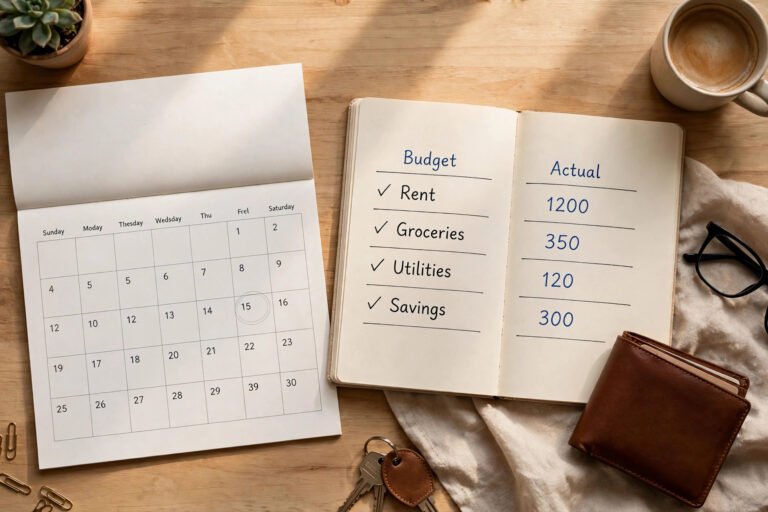
Learning how to save money on rent every month starts with a hard truth: rent is the biggest line in most household budgets, and it is the one people assume they cannot change. Groceries can be trimmed, subscriptions can be cancelled, but the rent figure on the lease feels fixed — signed, sealed, and out of your hands until moving day.
It is not fixed. Not really. Nearly half of America’s 44 million renters spend more than 30% of their income on housing, the point where shelter starts crowding out savings, debt payoff, and everything else. Yet most of those renters never ask for a lower rent, never check what similar apartments nearby actually cost, and never consider the smaller moves — a roommate, a longer lease, a parking space they do not use — that quietly add up to hundreds of dollars a month.
The good news is that rents have cooled nationally for more than two years, vacancy periods are getting longer in many cities, and landlords in competitive markets would rather keep a reliable tenant at a slightly lower rent than gamble on finding a new one. That gives you leverage — if you use it before your lease renews, not after.
This guide shows you how to save money on rent every month with real numbers, a word-for-word negotiation script, a worked household example, and a six-week renewal countdown you can copy. No moving required for most of these — though the biggest saving of all may be the move you were already considering.
How to Save Money on Rent Every Month: The Short Answer
To save money on rent every month, negotiate your lease at renewal, ask for a 5–10% cut or a free month, add a roommate to split the cost, and sign a longer lease. Start 4–6 weeks before renewal — most renters save $100 to $300 a month.
That is the whole method in one paragraph. The rest of this guide puts real dollars behind each move, because “negotiate” is advice nobody can act on, while “ask for $75 off, offer an 18-month lease, and bring three comparable listings” is a plan you can run this week.
How Much Can You Actually Save on Rent?
Before the tactics, here is what each one is worth on a typical $1,400-a-month rent — roughly the current US median. Your numbers will differ, but the scale is what matters: rent savings are measured in hundreds, not tens, because the base number is so large.
| Move | Typical monthly saving | Effort |
|---|---|---|
| Negotiate 5–10% off at renewal | $70–$140 | One conversation |
| Add a roommate (split a 2-bed) | $300–$600 | Finding the right person |
| Sign an 18–24 month lease | $50–$100 | One signature |
| Prepay several months for a discount | $70–$140 (5–10% off) | Needs cash up front |
| One free month spread over the year | ~$117 on $1,400 rent | Ask at renewal |
| Give up an unused parking space | $50–$100 | One email |
| Referral bonus from your landlord | $8–$42 a month (one-off $100–$500) | Telling a friend |
| DIY maintenance for a rent cut | $50–$150 | A few hours a month |
| Move to a cheaper area or smaller unit | $200–$500 | The big move |
| Rent in the winter low season | $50–$150 | Timing your move |
The key insight: you do not need all ten. Two or three moves stack. A $75 negotiation plus a $75 parking-space saving plus a $50 longer-lease discount is $200 a month — $2,400 a year — without a roommate and without moving. That is the size of an emergency fund, a holiday, or a serious dent in a credit card balance.
How to Save Money on Rent Every Month by Negotiating Your Lease
Negotiation is the highest-return move on this list because it costs nothing and takes one conversation. Yet it is also the move most renters skip, because nobody ever told them rent is negotiable. It is. Landlords negotiate because a vacant apartment costs them far more than a discount: every empty month on a $1,400 unit is $1,400 lost, plus cleaning, advertising, and the risk that the next tenant pays late or leaves early. A reliable tenant asking for $75 off a 12-month lease is offering to save the landlord money, not cost them money.
When to negotiate
Start four to six weeks before your lease expires — never the week it ends. At four to six weeks, the landlord still has time to say yes and keep you; at one week, they have already started advertising your unit and the conversation is over. The calendar helps too: October through February is the low-demand window in most US rental markets, when fewer people move and landlords are more flexible. A renewal that lands in winter is worth more than one in June.
What to say: a script that works
Keep it short, polite, and specific. Landlords respond to numbers, not complaints.
“Hi, I’ve really enjoyed living here and I’d like to renew. I’ve been here two years, always paid on time, and I’ve looked after the place. I’ve seen similar two-bedrooms in this building and nearby going for $1,300 to $1,350, while my renewal quote is $1,450. Would you be open to renewing at $1,375 for 18 months? That gives you a stable tenant and no vacancy or re-letting costs.”
That script works because it does four things at once: it shows you are a good tenant, it names a market price (not a feeling), it offers something in return (a longer lease), and it reminds the landlord what a vacancy actually costs. Practice it once out loud before you call or send it by email.
Bring proof, not opinions
Before the conversation, do three things:
- Research comparable rents. Print or screenshot three similar units nearby that cost less than yours. Data-backed requests are much harder to dismiss than “I think it’s too expensive.”
- Document your payment history. A record of on-time payments, and a short reference from a previous landlord if you have one, proves you are the tenant worth keeping.
- Know your walk-away number. Decide the highest rent you will accept before you call. If the landlord will not meet it, you need to be genuinely willing to move — and they need to believe it.
If they will not lower the monthly rate
Ask for non-rent concessions instead. Landlords often prefer these because they do not lower the headline rent for the next tenant. A free first month on a 12-month lease is worth about 8% off your yearly total — on $1,400 rent, that is $1,200 a year, or $100 a month. Waived parking fees, a reduced security deposit, new appliances, or free carpet cleaning are all real money. Get whatever you agree in writing before you sign.
Split the Cost: Roommates and Extra Rooms
If negotiation is the cheapest win, a roommate is the biggest. Splitting a two-bedroom apartment typically cuts each person’s rent by 30% to 50%, and renters who share save roughly $558 a month on average across 100 US cities, according to a 2025 SmartAsset study. On a $1,400 two-bedroom, that is the difference between paying $1,400 alone and $700 each.
If you already have a spare room, fill it. A roommate is the fastest way to save money on rent every month without moving or negotiating. Set the terms clearly up front: split rent and utilities by an agreed formula, agree on shared spaces and quiet hours, and put it in writing — even a simple one-page agreement avoids most of the arguments that end roommate arrangements early. Check your lease first: most allow an additional occupant with the landlord’s written approval, and asking is always cheaper than a lease violation.
If your place has no spare room, consider a smaller move within the same building. A one-bedroom in your current building is often $200 to $400 cheaper than your two-bedroom, and you keep the neighbourhood, the commute, and the landlord relationship. About 40% of renters use under half their space — if a room in your home is mostly storage, you are paying rent on a cupboard.
Rent out an extra room short-term, if your lease allows it. Some renters offset $200 to $400 a month by letting a spare room for short stays. This only works if your lease and local rules permit it, and it needs the landlord’s written permission — never do it quietly, because an unauthorised sublet can end a tenancy. For most people, a steady long-term roommate is simpler and safer.
Change the Deal: Longer Leases, Prepayment, and Private Landlords
Sign a longer lease
An 18- or 24-month lease instead of 12 signals stability, and landlords pay for stability. Many will drop the rent 5% for the longer term, and you lock in today’s price for two years instead of facing another increase next year. The trade-off is flexibility — do not sign two years if you might move for work — but if you plan to stay, the longer lease is free money.
Prepay for a discount
Paying several months in advance gives the landlord cash and zero risk of late payment, and the discount is typically 5% to 10%. On a $1,900 apartment, a 5% prepay discount saves $95 a month, or $1,140 over the year. This only makes sense if you have the cash without raiding your emergency fund — and if you do prepay, keep saving the monthly amount into a separate account anyway, so the habit (and the buffer) survives the discount.
Consider a private landlord
Large property companies run on fixed price lists; private landlords run on relationships. A private landlord with one or two units is more likely to negotiate, to accept a longer lease at a lower rate, or to trade a small rent cut for a tenant who handles minor maintenance. When you are next looking, filter for privately owned listings — the negotiation room is usually wider there.
Ask about referral bonuses
Many landlords pay $100 to $500 to a tenant who refers a new renter who signs a lease. If a friend is looking for a place, one introduction can cover a month’s saving. Ask your landlord or property manager whether a referral programme exists — most renters never ask, and the bonus sits unclaimed.
A Real Example: How One Household Saves $412 a Month
Meet Daniel and Priya, renting a two-bedroom apartment for $1,450 a month in a mid-sized US city. Their lease renews in November — the winter low season — and their combined take-home pay is about $4,800 a month. Rent is eating 30% of it, and they want it under 25%. Here is exactly what they did:
| Move | What they did | Monthly saving |
|---|---|---|
| Negotiated at renewal | Asked for $1,375, settled at $1,390 for an 18-month lease | $60 |
| Gave up the second parking space | They share one car; the second space was unused | $75 |
| DIY maintenance deal | Daniel handles lawn care and minor fixes, agreed in writing | $80 |
| Referral bonus | Referred a colleague who signed for the empty unit upstairs | $33 (one-off $400 spread over 12 months) |
| Renter’s insurance switch | Shopped around: $28 a month down to $15 | $13 |
| Utility habits | LED bulbs, shorter showers, thermostat setback at night | $51 |
| Prepay discount | Paid 3 months up front at renewal for a 5% discount on those months | $100 (for 3 months) |
| Total | $412 a month |
Notice what is missing: no roommate, no move, no giving anything up that mattered. The biggest single line is the prepay discount, and even without it the total is $312 a month — $3,744 a year — from one negotiation, one email about parking, and a written maintenance agreement. The money now goes into a separate savings account the day after payday, and it is on track to become their house down payment fund.
Your mix will look different, and that is fine. Maybe your win is a roommate ($500), or a winter move ($200), or a free month at renewal ($117). The point of the example is to prove the total is a stack of findable amounts, not one giant sacrifice — and that the stack starts with a single conversation six weeks before renewal.
The 6-Week Renewal Countdown
Rent savings are won or lost on timing. If you start the week your lease expires, you have no leverage. Start six weeks out and the whole process is calm and cheap.
| When | Action |
|---|---|
| 6 weeks before | Check your lease: renewal date, notice period, and any increase clause. Research 3 comparable rents nearby. |
| 5 weeks before | Decide your target rent and your walk-away number. Gather your on-time payment record. |
| 4 weeks before | Have the negotiation conversation — call or email, with the script and the comparable listings. |
| 3 weeks before | If they agree, get it in writing. If they refuse, ask for non-rent concessions (free month, waived fees). |
| 2 weeks before | Decide: renew, or start looking. If moving, search winter listings and shortlist cheaper areas. |
| 1 week before | Sign the new lease or give notice. Never let a lease roll over to month-to-month at a higher rate by default. |
Put the renewal date in your calendar the day you sign any lease. A reminder six weeks before renewal is the single cheapest habit in this whole guide — it is the difference between negotiating from strength and discovering the increase in an email you cannot answer.
Smaller Wins That Add Up
Give up what you do not use. A parking space you never fill costs $50 to $100 a month in many buildings. A storage unit in the building, a second gym pass bundled into the rent, a premium cable package you never watch — each one is a line item to question at renewal.
Move in winter, if you are moving anyway. Fewer people move between October and February, so landlords offer concessions they would never offer in June: a free month, waived application fees, a lower deposit. If your lease ends in summer, a 6-month renewal can shift your next move into the cheap season.
Look one neighbourhood further out. The rent gradient is steep: one stop further on the train, or one neighbourhood over, often saves $200 to $400 a month for the same size apartment. Before you dismiss it, price the extra commute honestly — 20 extra minutes a day is real, but $300 a month is $3,600 a year, which buys a lot of patience.
Trade skills for rent. Can you paint, do basic plumbing, manage a small garden, or handle simple repairs? Offer it in writing: a defined set of tasks for a defined rent reduction. Landlords pay contractors $50 to $100 an hour for this work — a $100 monthly cut for a few hours of maintenance is a bargain for both sides. Always get the agreement in writing, with the tasks and the discount spelled out.
Keep the utilities separate from the rent. Rent is not just the cheque you hand over. Electricity can run $100 to $200 a month, water and gas another $50, internet $60 or more, and parking $50 to $100. Budget 15–25% on top of base rent for the true cost, and attack the add-ons too — the utilities article on this site covers the free changes first, and they stack with everything here.
Mistakes That Cost Renters Money
Never asking. The most expensive mistake is silence. Landlords expect negotiation at renewal; a polite, evidence-backed ask costs nothing and succeeds far more often than renters believe. The worst answer is “no” — and even then, you have learned where you stand.
Accepting the first renewal offer. The renewal letter is an opening bid, not a final price. Treat it the way you would treat the sticker price on a car: the number moves when you push back with comparable rents and a longer lease on the table.
Paying rent by credit card. Some services let you pay rent on a card for points, but the fees — often 2–3% — wipe out the rewards and turn a $1,400 rent into a $1,440 cost. Pay from your bank account, on time, every time. On-time payments are also the evidence that makes your next negotiation work.
Letting the lease roll over. A lease that lapses into month-to-month usually costs more, and it leaves you exposed to a sudden increase or a 30-day notice. Decide before the deadline, every time.
Moving without doing the maths. A cheaper apartment 45 minutes further away can cost more than it saves once you count fuel, fares, and your time. Always compare the total monthly cost — rent plus utilities plus transport — not the headline rent alone.
Frequently Asked Questions
How can I save money on rent every month on a low income? Start with the free moves: negotiate at renewal (even $50 off matters), ask about a longer lease for a lower rate, give up a parking space you do not use, and check whether you qualify for a housing voucher or local rent assistance. A roommate is the biggest single lever — splitting a two-bedroom can cut your share by 30–50%.
Can I negotiate rent if I have only lived here a year? Yes. One year of on-time payments is enough to prove you are a reliable tenant, and that is what landlords value most. Bring your payment record and comparable listings, and ask 4–6 weeks before renewal. Even a small reduction — $50 a month — is $600 a year.
Is it better to ask for lower rent or a free month? Do the maths on your rent. A free month on a 12-month lease is worth about 8.3% of your annual rent — on $1,400, that is $1,200 a year, or $100 a month. A straight 5% cut is $70 a month. The free month is usually worth more, and landlords often prefer it because it does not lower the headline rent.
What if my landlord refuses to negotiate? Ask for non-rent concessions: waived parking, a lower deposit, new appliances, or free carpet cleaning. If nothing moves, start looking — a winter move, a smaller unit, or one neighbourhood further out can save $200–$500 a month, and a credible willingness to leave is what makes the next negotiation work.
How much rent should I be paying? The common rule is 30% of your gross monthly income — on $4,000 a month, that is $1,200 max. In expensive cities that cap is hard to hit, so treat it as a target, not a pass-or-fail test. If rent plus utilities is over 40% of your take-home pay, the moves in this guide are worth doing in order, starting with the negotiation.
Start Six Weeks Before Your Lease Ends
You do not need to move house to save money on rent every month. You need one conversation, six weeks before renewal, with three comparable listings and a clear ask. That conversation alone is worth $50 to $140 a month for most renters — and the parking space, the longer lease, and the maintenance swap sitting next to it can double that without anyone moving a box.
Check your lease tonight. Find the renewal date, put a reminder in your calendar six weeks before it, and start the research. When the reminder goes off, you will be the tenant with the numbers, the payment record, and the plan — and that is the tenant landlords say yes to.