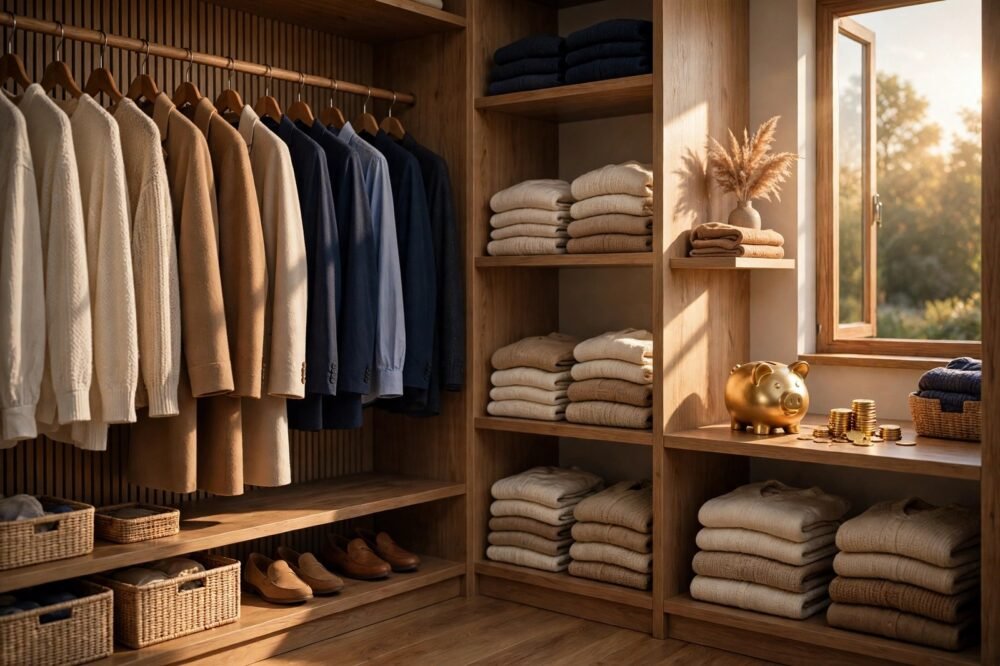
Clothes are one of those expenses that never feel like a big deal — until you add them up. A $28 shirt here, a $60 pair of jeans there, a “just browsing” trip that ends with three bags, and suddenly you have spent $150 in a month without buying anything you truly needed. For the average household, clothing quietly eats 3% to 5% of take-home pay, and most of that money goes to pieces that get worn a handful of times — or never at all.
The good news is that clothing is one of the easiest budgets to shrink without feeling deprived. You do not need to stop buying clothes, wear rags, or give up looking good. You need a small budget, a simple test before every purchase, and a habit of buying secondhand and on sale first. This guide shows you how to save money on clothes every month with a realistic clothing budget, cost-per-wear math, a capsule wardrobe that actually works, and a 30-day plan you can start this week.
How to Save Money on Clothes Every Month: The Short Answer
To save money on clothes every month, cap clothing at 3% to 5% of your take-home pay, buy only pieces that pass the cost-per-wear test (price divided by expected wears should be under $3), shop thrift and end-of-season sales first, and build a small capsule wardrobe of versatile pieces that mix and match. Skip impulse buys with a 72-hour waiting rule.
That is the whole system in one paragraph. The rest of this guide puts real numbers behind it, because “spend less on clothes” only works when you know exactly how much less — and where the savings come from.
How Much Should You Spend on Clothes Each Month?
Before you can save, you need a number. Financial planners generally suggest spending 3% to 5% of your take-home pay on clothing. That is the range that keeps you well-dressed without crowding out rent, food, and savings.
Here is what that looks like at different incomes:
| Monthly take-home pay | 3% clothing budget | 5% clothing budget |
|---|---|---|
| $2,000 | $60 | $100 |
| $3,000 | $90 | $150 |
| $4,000 | $120 | $200 |
| $5,000 | $150 | $250 |
If you are on a tight budget, start at 3% — or even lower. A $60 monthly clothing budget sounds small, but it adds up to $720 a year, which is plenty when you shop the way this guide shows you. The point of the budget is not to punish yourself. It is to give every clothing dollar a job before you walk into a store.
Set it up in five minutes:
- Open a separate category in your budgeting app (or a notes app) called “Clothes.”
- Move your monthly clothing amount into it on payday — in cash in an envelope if that helps you stick to it.
- When the envelope is empty, clothing shopping stops until next month. No exceptions, no borrowing from groceries.
- Roll unspent money forward. A quiet month means a bigger budget when winter coats go on sale.
Most people are shocked the first month they track clothing spending. The average American underestimates their subscription spending by over $130 a month — and clothing has the same blind spot, because it comes in small, forgettable purchases instead of one big bill.
Step 1: Use Cost-per-Wear Before You Buy Anything
The single most powerful idea in this guide is cost per wear. It is simple division: the price of an item divided by the number of times you will actually wear it. It instantly separates a bargain from a waste of money.
- A $120 coat worn 100 times costs $1.20 per wear. That is a great buy.
- A $25 trendy top worn 3 times costs $8.33 per wear. That is expensive clothing disguised as cheap clothing.
- A $60 pair of jeans worn 80 times costs $0.75 per wear. That is the cheapest item in your closet.
The rule: before you buy, ask yourself honestly how many times you will wear it in the next year. Divide the price by that number. If the answer is over $3 per wear, put it back — unless it is a special-occasion piece you genuinely need.
This one test kills most impulse buys on its own. That $40 sale shirt feels like a deal until you admit you will wear it twice. The $90 quality shoes feel expensive until you realise you will wear them 200 times and they cost less than 50 cents a wear.
Three questions to ask in the aisle:
- Will this finish at least three outfits I already own? If not, it is not a bargain — it is the start of three more purchases.
- Is this a need, a replacement, or a want? Needs and replacements get bought. Wants wait 72 hours.
- Would I buy it at full price? If the only reason you want it is the discount, you do not want the item — you want the feeling of a deal.
Step 2: Buy Secondhand First
Secondhand is the fastest way to cut a clothing bill in half without changing what you wear. A good thrift store, consignment shop, or resale app sells the same brands for 50% to 80% less than retail — often barely worn, sometimes with the tags still on.
Where to look:
- Thrift and consignment stores for everyday pieces, work clothes, and kids’ clothes. Go early in the week, when new stock hits the racks, and check the clearance colour-tag sale first.
- Resale apps and sites for specific brands and sizes — search the exact item you need instead of browsing aimlessly, which is how secondhand shopping turns into overspending.
- Clothing swaps with friends or neighbours. Everyone brings clean, gently used clothes they no longer wear, and everyone leaves with “new” pieces for free.
- Kids’ resale stores for children’s clothes. Kids outgrow clothes before they wear them out, so resale shops are full of nearly new items at a fraction of retail — and you can sell last season’s sizes back for store credit.
A worked example: a family that spends $150 a month on clothes switches half its purchases to secondhand at an average 60% discount. That is $75 of spending cut to $30 — a saving of $45 a month, or $540 a year — for wearing the same kinds of clothes.
Secondhand rules that keep it cheap:
- Shop with a list. “Black work trousers, size 8” beats “let’s see what’s here” every time.
- Check quality before price: seams, zips, buttons, and fabric. A $5 shirt with a broken zip is not a bargain.
- Sell what you no longer wear. One bag of clothes sold on a resale app can fund the next month’s clothing budget entirely.
- Skip fast-fashion secondhand. A used $8 fast-fashion top that falls apart after five washes costs more per wear than a $25 quality piece that lasts two years.
Step 3: Time Your Purchases and Never Pay Full Price
Clothing is one of the most predictable things to buy on sale. Retailers run the same sale calendar every year, and the discounts are deep if you can wait a few weeks.
| When to buy | What is cheapest | Typical discount |
|---|---|---|
| January | Winter coats, knitwear, boots | 50–70% off |
| June–July | Spring and summer clothes | 40–60% off |
| Holiday weekends (MLK Day, Memorial Day, Labor Day) | Almost everything | 30–50% off |
| Black Friday / Cyber Monday | Everything, especially online | 30–60% off |
| End of any season | Last season’s styles | 50–75% off |
How to use the calendar:
- Keep a short running list of what you actually need — winter coat, work shoes, kids’ jeans — and buy each item when its season ends, not when it starts.
- Buy next year’s sizes for kids at end-of-season sales. A winter coat bought in January for 60% off, one size up, is the cheapest coat you will ever buy.
- Sign up for the email list of two or three stores you actually shop at, and ignore the rest. One well-timed 40%-off coupon beats ten ignored newsletters.
- Abandon your online cart on purpose. Many stores email a 10% to 20% discount code within 24 to 72 hours to tempt you back — and the waiting period doubles as your impulse-buy filter.
- Ask about price adjustments. If something you bought goes on sale within 14 to 30 days, most stores will refund the difference if you ask. Keep the receipt.
The 72-hour rule is the backbone of all of this. When you want something that is not on your list, wait 72 hours before buying. Most urges fade. The ones that survive three days are usually genuine needs — and by then you may have found the same thing cheaper secondhand or on sale.
Step 4: Build a Capsule Wardrobe
A capsule wardrobe is a small collection of versatile, good-quality pieces that all mix and match. Instead of a closet full of clothes and “nothing to wear,” you own fewer items that combine into dozens of outfits. It is the single best way to stop buying clothes you do not need.
A starter capsule (about 25–30 pieces, not counting underwear and gym clothes):
- 2 pairs of jeans or trousers (one dark, one lighter)
- 2 pairs of work-appropriate trousers or a skirt
- 5–7 tops that go with everything (neutral colours: black, white, navy, grey)
- 2–3 layering pieces (cardigan, blazer, denim jacket)
- 1 dress or smart outfit for occasions
- 1 coat for cold weather, 1 lighter jacket
- 2 pairs of shoes (one everyday, one smarter)
- Accessories in one or two accent colours to change the look
Why it saves money:
- Every new piece must work with at least three outfits you already own, or you do not buy it. That one rule stops most impulse purchases cold.
- You stop buying duplicates. When everything matches, you notice you already own four black tops — and you stop buying a fifth.
- Quality beats quantity. A $60 shirt that lasts three years costs $20 a year. A $15 shirt that falls apart in six months costs $30 a year — and looks worse the whole time.
- Getting dressed takes five minutes. Decision fatigue is a real reason people shop: a chaotic closet makes you feel like you have nothing, even when it is full.
Start by pulling everything out of your closet and sorting it into three piles: keep, sell or donate, and maybe. Anything you have not worn in a year goes in the sell-or-donate pile. Then look at what is left and write down the gaps — those gaps, and only those gaps, are your shopping list.
Step 5: Make Your Clothes Last Longer
The cheapest clothes you will ever own are the ones already in your closet. Every extra year you get out of a garment is money you do not spend replacing it — and most clothes die from bad care, not old age.
- Wash less, wash cold. Most clothes do not need washing after every wear. Wash in cold water, skip the dryer when you can, and clothes keep their shape and colour far longer.
- Learn three tiny repairs. Sewing on a button, fixing a hem, and closing a small seam take five minutes each and save a garment that would otherwise be thrown away. A basic sewing kit costs less than one takeaway coffee.
- Treat stains immediately. A stain set by the dryer is often permanent; a stain rinsed in cold water right away usually comes out.
- Store clothes properly. Fold knitwear instead of hanging it (hangers stretch it out), use proper hangers for jackets, and keep shoes stuffed so they hold their shape.
- Rotate and rest. Shoes worn every day wear out twice as fast as shoes rotated with a second pair. The same is true of anything you wear daily.
The hidden cost of cheap clothes: a $10 fast-fashion shirt that lasts 10 washes costs $1 per wear. A $30 quality shirt that lasts 100 washes costs $0.30 per wear. Buying cheap is often the most expensive way to dress.
How to Save Money on Clothes Every Month for Kids
Kids are the hardest part of a clothing budget because they outgrow everything — but they are also where the biggest savings hide.
- Buy one size up at end-of-season sales. A $40 winter coat at 60% off in January costs $16. Buy next year’s size and store it.
- Use kids’ resale stores in both directions. Buy nearly new clothes for half price, then sell last season’s outgrown clothes back for credit toward the next size.
- Accept hand-me-downs proudly. Cousins, friends, and neighbours with older kids are a free clothing supply. Offer your outgrown clothes onward — it keeps the chain going.
- Keep school and play clothes separate. Cheap, sturdy clothes for play and school mean the good outfits stay good — and you replace the cheap ones less often because they are built for rough use.
- Do a seasonal swap twice a year. Every spring and autumn, sort out what still fits, what to hand down, and what to buy. One organised swap beats a dozen panicked shopping trips.
A 30-Day Plan to Cut Your Clothing Spending
If you want results this month, not someday, here is the plan:
- Days 1–3: Track every clothing-related purchase from the last month and set your budget at 3% to 5% of take-home pay.
- Days 4–7: Clean out the closet. Sell what you can, donate the rest, and write your gap list — the only things you are allowed to buy.
- Days 8–14: Buy nothing. Use the 72-hour rule on anything you want, and check thrift stores and resale apps for the items on your gap list first.
- Days 15–21: Build your capsule. Plan 10 outfits from what you already own and photograph them, so “nothing to wear” mornings disappear.
- Days 22–30: Buy only gap-list items, secondhand or on sale first, using the cost-per-wear test. Move whatever budget is left into savings at month’s end.
Most people who follow this plan save $50 to $100 in the first month alone — and the savings repeat every month, because the habits, not willpower, do the work.
Common Mistakes to Avoid
- Buying because it is on sale. A 70%-off item you never wear costs 100% more than not buying it.
- Shopping without a list. Browsing is the most expensive hobby there is. Every trip starts with a list of gaps, or it does not start.
- Ignoring the real cost of “cheap.” Fast fashion that falls apart in a season costs more per wear than quality pieces that last years.
- Keeping clothes that do not fit. A closet full of “someday” sizes makes you feel like you have nothing to wear — and sends you shopping. Let them go.
- Forgetting the one-in, one-out rule. For every new item that comes in, one item goes out — sold, donated, or recycled. It keeps the closet (and the budget) honest.
- Paying for dry cleaning you do not need. Many “dry clean only” labels are cautious, not mandatory. Hand-wash or use a gentle cold cycle where the fabric allows it — and skip dry cleaning for everyday items entirely.
Frequently Asked Questions
How much should I spend on clothes per month? Aim for 3% to 5% of your take-home pay — $60 to $100 a month on a $2,000 income, or $90 to $150 on $3,000. On a tight budget, start at 3% and shop secondhand first; $60 a month goes a long way when thrift and end-of-season sales are your first stop.
What is cost per wear and why does it matter? Cost per wear is the price of an item divided by how many times you wear it. A $120 coat worn 100 times costs $1.20 per wear — a great buy. A $25 top worn 3 times costs $8.33 per wear — expensive clothing disguised as cheap. Use $3 per wear as your ceiling before buying.
Is buying secondhand clothes actually cheaper? Yes — thrift and resale prices are typically 50% to 80% below retail for the same brands, often barely worn. A family that moves half its clothing spending to secondhand can save $40 to $60 a month. Shop with a list, check seams and zips, and sell what you no longer wear to fund the next round.
How can I build a capsule wardrobe on a budget? Start with what you already own: keep the versatile, neutral pieces and remove what you have not worn in a year. Write down the gaps — usually 5 to 8 items — and fill them secondhand or on sale, one at a time. Every new piece must work with at least three outfits you already own.
How do I stop impulse buying clothes? Use the 72-hour rule: wait three days before buying anything that is not on your list. Most urges fade. Also unsubscribe from store emails that tempt you daily, shop with a written gap list, and abandon online carts on purpose — stores often send a discount code within a day or two.
The Bottom Line
You do not need a bigger clothing budget — you need a smaller, smarter one. Cap clothing at 3% to 5% of your take-home pay, run every purchase through the cost-per-wear test, buy secondhand and end-of-season first, and keep a small capsule wardrobe where everything matches. Add the 72-hour rule for impulse buys and a 30-day plan to get started, and you can save $50 to $100 a month without looking any different — except better dressed, because every piece you own is one you chose on purpose. Start this week: clean out one drawer, write your gap list, and let the savings begin.